Grid Carbon Analysis

Analyze emissions across the US grid, compare states, and quantify your project's impact

~10 min
4 tools
For Carbon & ESG Analysts
1

Check Your Grid's Carbon Intensity

Every Scope 2 emissions calculation starts with a single number: how much CO2 your local grid emits per megawatt-hour. Gridleaf pulls this directly from EPA eGRID data, so you never have to dig through spreadsheets again.

gridkit_carbon_intensity
Prompt
What's the carbon intensity of California's electric grid?

Results

State
CA
eGRID Subregion
CAMX
CO2 Emission Rate
498 lb/MWh (225.9 kg/MWh)
vs. US Average
39% cleaner than 818 lb/MWh
Data Source
EPA eGRID 2022
Insight: Knowing your grid's carbon intensity is the foundation of any Scope 2 emissions calculation. California's rate of 498 lb/MWh means each MWh of grid power carries roughly a quarter-ton of CO2.
2

Compare States for Maximum Impact

If you're siting a clean energy project or advising on carbon offset purchases, location is everything. Gridleaf can rank all 50 states by carbon intensity in a single call, letting you immediately see where solar, wind, or storage investments avoid the most CO2.

gridkit_carbon_ranking
Prompt
Rank all US states by grid carbon intensity from cleanest to dirtiest

Carbon Intensity Ranking (selected states)
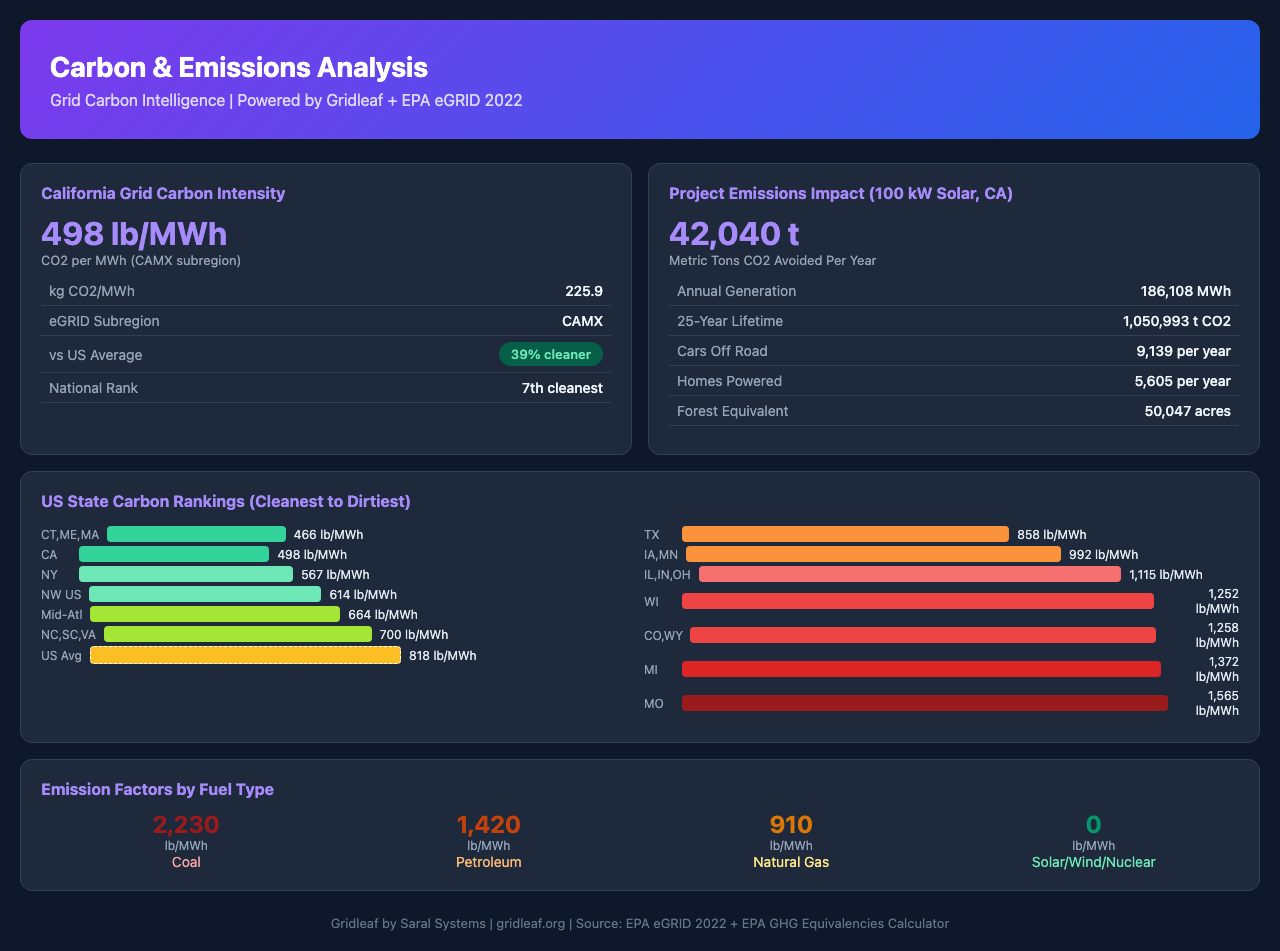
CT / ME / MA / NH / RI
466 lbCleanest
California (CA)
498 lb7th
US Average
818 lbAvg
Texas (TX)
858 lb
Missouri (MO)
1,565 lbDirtiest
Carbon intensity dashboard showing state-by-state rankings
Insight: Building solar in Missouri avoids 3.1x more CO2 than in Connecticut — location matters enormously for carbon impact. This ranking is essential for prioritizing carbon offset investments and siting decisions.
3

Understand Emission Factors by Fuel Type

State-level averages blend many fuel sources together. To build a compelling narrative in your ESG report, you need to know the emission factor for each fuel type individually. This is what drives the coal-to-gas transition story, and it's what makes renewable energy impactful.

gridkit_emission_factors
Prompt
What are the CO2 emission factors for different fuel types?

Emission Factors by Fuel Type

Coal
2,230 lb/MWh
Petroleum
1,420 lb/MWh
Natural Gas
910 lb/MWh
Nuclear
0 lb/MWh
Hydro
0 lb/MWh
Wind
0 lb/MWh
Solar
0 lb/MWh
Geothermal
0 lb/MWh
Insight: The coal-to-gas transition alone reduces emissions by 59%. Renewables take it to zero. This breakdown is critical for marginal emission rate analysis and avoided-cost modeling.
4

Calculate Your Project's Impact

Now bring it all together. Give Gridleaf a project's annual generation and location, and it calculates lifetime CO2 avoidance with real-world equivalencies you can drop directly into ESG reports, investor decks, and carbon credit applications.

gridkit_project_emissions
Prompt
Calculate CO2 avoided by a solar project generating 186,108 MWh per year in California

Project Impact Summary

Annual CO2 Avoided
42,040 metric tons
25-Year Lifetime
1,050,993 metric tons

Real-World Equivalencies

9,139
Cars off road
5,605
Homes powered
50,047
Acres of forest
Insight: These equivalencies are directly usable in ESG reports, investor presentations, and carbon credit applications. Gridleaf sources all calculations from EPA methodologies.

What You've Learned

How to look up grid carbon intensity for any US state using EPA eGRID data
How to rank and compare states to identify where clean energy has the greatest impact
How emission factors differ by fuel type — and why the coal-to-gas transition matters
How to calculate lifetime CO2 avoidance with real-world equivalencies for stakeholder reporting